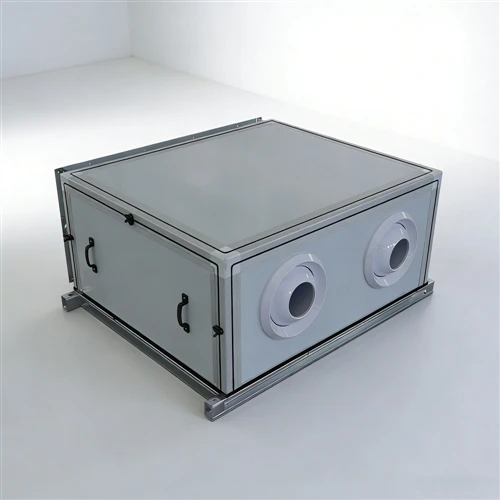
Air Source Heat Pumps represent a new generation of energy-saving and eco-friendly HVAC equipment. Based on the inverse Carnot thermodynamic cycle, they adopt an energy conversion mechanism distinct from conventional electric and gas heating systems and serve as a typical form of renewable energy utilization. Their core working principle is to transfer and upgrade ambient heat rather than generate heat directly, which constitutes the fundamental reason for their outstanding energy-saving performance. Using free atmospheric heat as the heat source, the units can harvest low-grade thermal energy under both normal and low-temperature conditions. Such low-grade heat cannot be used directly for space heating and must be upgraded through the equipment's thermodynamic system.
A complete system consists of four core components: a compressor, an evaporator, a condenser and a throttling device, which work in coordination to complete the entire heat conversion cycle. First, the evaporator performs full heat exchange with ambient air, absorbs low-grade thermal energy, and vaporizes the internal refrigerant. The gaseous refrigerant is then drawn into the compressor, where electrical power increases its pressure and temperature to form high-temperature, high-pressure gaseous refrigerant. This high-energy refrigerant flows into the condenser and releases high-grade heat through heat exchange with water or air to meet heating, hot water and cooling demands. Finally, the cooled and depressurized refrigerant returns to the evaporator via the throttling device to sustain continuous cyclic operation.
In terms of energy characteristics, Air Source Heat Pumps are classified as clean energy equipment. They operate without open flames, combustion processes, exhaust emissions or solid residues, completely avoiding carbon emissions and safety hazards such as carbon monoxide poisoning caused by traditional heating systems. Featuring strong environmental adaptability and minimal seasonal and geographical limitations, standard models operate stably within a temperature range of -7℃ to 43℃, while specialized low-temperature models can withstand extreme cold conditions as low as -25℃ in northern regions and deliver year-round efficient operation. Unlike solar heat pumps that rely on sunlight or ground source heat pumps that require complex underground construction, Air Source Heat Pumps feature simple installation, low site requirements and extensive applicability. As mainstream equipment for residential and commercial HVAC upgrading and clean energy replacement, they are widely adopted to replace conventional coal-fired, gas-fired and electric heating systems, aligning with national energy conservation and low-carbon development strategies.
Furthermore, Air Source Heat Pumps adopt an integrated multi-functional design. A single unit can replace separate air conditioners, water heaters and heating furnaces, integrating cooling, space heating and domestic hot water functions. This integration effectively reduces equipment procurement and installation costs. Featuring fully automated intelligent operation, the units support precise temperature adjustment and scheduled start-stop without manual supervision. Adaptable to households, retail stores, factories, hotels and other scenarios, they are all-in-one HVAC solutions that balance energy efficiency, operational safety and practical convenience.