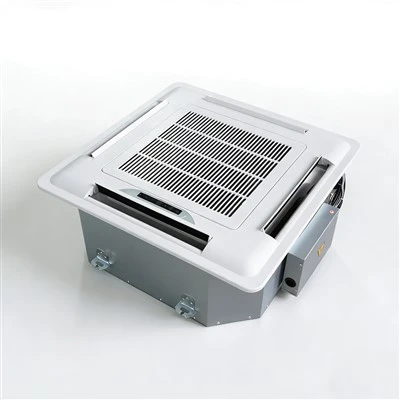
Many customers ask whether running Vertical Exposed Fan Coil Units for extended periods will degrade indoor air quality. They worry that equipment operation releases hazardous substances or makes indoor air turbid and stale. This is a common concern for residential and office applications. First of all, a fan coil unit is indoor air circulation equipment. It does not change the total volume of indoor air, consume oxygen or burn materials, so it will not produce carbon monoxide, formaldehyde or other harmful gases. The equipment itself cannot create pollutants.
Its working principle is straightforward. The fan draws in existing room air, which passes through heat exchange components for heating or cooling before being sent back into the room. Throughout the process, only original indoor air is circulated for heat exchange, and no new pollutants are generated. Therefore, simply keeping the unit running for a long time will not reduce baseline indoor air quality or create toxic air.
The perceived deterioration of air quality is usually not pollution generated by the unit itself, but dust stirred up by airflow. Fine floating dust, hair and pollen exist indoors all the time. When the air is still, dust settles on floors and furniture and is barely visible. Once the Vertical Exposed Fan Coil Unit runs continuously, the fan drives persistent air circulation and lifts settled fine dust into suspension. If the filter collects large amounts of dust without timely cleaning, particles trapped on the filter will be blown back into the room as air flows through. The concentration of particulate matter rises, making air look hazy and irritating to people. Many people mistakenly think the unit contaminates the air.

We need to differentiate two concepts: generating new pollutants and disturbing existing dust. The unit does not produce new contaminants; it only resuspends dust already present in the room. With routine maintenance and regular filter cleaning to trap dust, such dust disturbance can be effectively reduced. A clean filter intercepts hair and floating particles. Air circulated through the unit becomes cleaner. Continuous air circulation also alleviates stuffy indoor sensations.
Some customers are concerned that indoor air quality drops when the room is tightly sealed during long unit operation. However, the root cause of this problem is insufficient fresh air supply in closed rooms rather than the fan coil unit. Even without turning on the fan coil unit, carbon dioxide concentration rises gradually as occupants breathe in an enclosed room. The Vertical Exposed Fan Coil Unit merely circulates indoor air and does not introduce fresh outdoor air. It neither aggravates air pollution in sealed spaces nor performs ventilation. Fresh air systems are required to improve air exchange in enclosed rooms, which is independent of fan coil units.
There is another point of attention in humid environments. Some users fear that mold will grow during long operation and contaminate air. Mold growth requires sustained dampness and standing water. If condensed water inside the unit drains smoothly without stagnant sewage, mold spores will not multiply and spread into the air along with airflow. Drainage blockage and accumulated moisture are the prerequisites for mold problems, which are secondary issues caused by inadequate maintenance rather than inevitable results of prolonged unit operation. Timely cleaning and smooth drainage can prevent mold growth.
Continuous air circulation also brings certain benefits in practical use. Corners of sealed rooms easily trap moisture and stale odors. The airflow driven by the fan coil unit balances temperature and humidity across the room, reduces damp dead zones and inhibits odor and mold buildup. From this perspective, proper operation helps maintain a healthy indoor air environment.
To conclude, prolonged operation of the Vertical Exposed Fan Coil Unit itself will not reduce indoor air quality. The equipment does not release toxic and harmful substances. The only factor that may affect air perception is floating dust stirred up by airflow. Regular filter cleaning and unobstructed drainage can avoid dust suspension. Continuous air circulation also helps improve stuffy and damp indoor conditions.